

A critical look at some of the major changes
happening to social housing in the UK—and its likely effects on tenants
and those in housing need.
The Demolition of Social Housing?
Since the 1970s successive governments have shown a growing hostility to the concept of state-subsidised housing for the lower orders. Earlier Tory regimes had implemented limited 'right-to-buy' schemes for some council tenants, and a 1970s Labour government had considered similar schemes but abandoned it as too controversial and potentially divisive a policy for the Party(1). Coming to power in 1979, Thatcher's Tories had no such qualms or obstacles and tenants snapped up their council homes at knock-down prices in this first wave of mass buy-outs (with the discounts offered at the time for many tenants mortgage payments worked out cheaper than continuing to rent).
In tandem with the share options offered in the sell-off of other state assets, eg energy and telecommunications companies, the populist myth of the property-owning, share-owning democracy was formed; the democratisation of speculation for the masses.
But social housing still provides homes for millions of lower income tenants who will never be able to afford to buy themselves property. And this, as a component of the other economic and ideological changes of the past 30 years, reveals a contradiction; a madly accelerating property market pushing rent and sale prices to absurd levels alongside a low wage workforce manning the service industries that now dominate much of the UK economy. The main cost of reproduction (ie, reproducing their own ability to labour) of the poorer parts of the workforce is housing; and for a low wage economy to be viable this means the state must subsidise - via housing benefit payments - these reproduction costs. This alone makes the 'benefit scrounger' mythology of the tabloids quite laughable(2); it is employers and landlords who are most profiting from the housing benefit and tax credits payments that subsidise the low wages they pay and high rents they charge. The average private sector rent has risen by 63% since 1997. If governments sincerely wanted to effectively reduce housing benefit costs, there's a simple solution; bring back strict rent control measures for the private sector (relating them to average incomes) to make rents more affordable. (This, alongside long-term security of tenure, is how much housing has been provided elsewhere in Europe(3).) Building more rent-controlled social housing would have a similar effect. But that would be against all their heartfelt principles...
In many discussions of social housing its opponents repeat the misleading complaint that it is 'subsidised housing'. Yet in fact - once the build costs are soon repaid - council housing returns an enormous profit to the Treasury, recently running into hundreds of millions annually!(4) One can also add in the massive profits made since the 1980s from the sale of over two million council houses. Similarly, the larger Housing Associations are sitting on massive cash 'reserves' or 'surplus' (these 'charitable bodies' call it anything but what it is - i.e., profit).(5) In fact, head for head, social housing tenants are far less subsidised than are homeowners, commercial businesses, landlords or politicians. It seems that what its opponents most resent when they moan that social housing is 'subsidised' is not that it doesn't cover its costs, which it more than does - but just that the maximum possible market rent is not recovered from every property. For these rabid profiteers, market prices are always unchallengeable truths and the last word, therefore all satisfaction of human need must be regulated and limited by them.(6)
In the past 25 years Housing Associations (HAs) have been promoted by successive governments as a more tolerable provider of social housing who could be more easily steered towards a market-orientated approach(7). Despite a nominal official charitable status(8), HAs are often large commercial enterprises, paying their Chief Execs six-figure salaries, having large incomes and accumulated 'reserves' (as 'charities', they can't call it profit). Taking both state subsidies and commercial loans, HAs have become the main providers of 'part-buy, part rent' schemes. 70 percent of homes in new build projects are for sale or rent at market prices, with only 30 percent for social housing rental. So HAs often use their social housing stock as assets to guarantee the bank loans that fund their property speculation(9). Many have sister companies/wings that are solely commercial property developers.
Despite being the main providers of so-called "affordable housing", the part buy-part rent schemes are far beyond the affordability of those most in housing need and appear to mainly provide a first foot on the property ladder for young single professionals. With 5 million on social housing waiting lists nationwide, one can see that the needs of the property market, as always, take precedent over satisfaction of needs. There are over 700,000 empty homes in the UK(10). An artificially induced housing shortage maintains high prices, with the poorest exploited the most.
* * *
The present Con-Dem coalition government are proposing changes in their new Localism Bill
that may mean the effective end of access to social housing for many of
those most in need. Some of the contradictions of the Bill's goals may
make them unworkable in practice, but the changes proposed include;Restricting access to social housing. At present anyone can apply for social housing and will be assessed, under nationally recognised legal guidelines, for priority according to need. But under the new Bill councils will be able to draw up their own criteria of eligibility for applying to join the housing waiting list; this is apparently intended to be a means testing even of being considered for housing.
An end to security of tenure. Councils and HAs will have the option to issue only fixed-term tenancies (minimum two years) to new tenants. This is despite the government claims to want to create 'sustainable communities'. Means testing is also proposed for new tenancies; so if a tenant's income rises above a certain level they must leave social housing.
When the last Labour government considered in 2007 a similar attack on tenancies 37 Lib Dem MPs voiced their opposition in Parliament, "opposing both the stigmatisation of council housing as housing of last resort and proposals to means test or time limit secure tenancies". Two of these two-faced MPS are now cabinet ministers and another six are junior ministers in the coalition government now implementing the present 'time limited secure tenancies'.
Before being elected David Cameron claimed in April 2010 ‘The Conservative Party has ‘no policy to change the current or future security of tenure of tenants in social housing.’ (Inside Housing - 6 August 2010) Yet soon after becoming PM he announced a review of social housing tenures.(11) (As well as owning ‘various property assets’ worth millions, including an expensive London home and a large country pad in the Cotswolds, Cameron himself is currently a rent-free tenant of the state at Downing St and has the use of the traditional PM’s country retreat at Chequers.)
But the ill-thought out proposals may well fail to achieve their aims. A survey of
"an Australian model used in New South Wales ... found that fewer than 1% of fixed-term tenancies had actually been terminated by the scheme - a complete reversal of what the government hopes to achieve by freeing up housing stock for the most vulnerable.So tenants can lose their homes by getting a job or pay rise - and then be forced to pay higher rent in the private sector, so reducing overall income...
Fixed-term tenancies could also prove costly, as landlords would be forced to undertake lengthy resident reviews every two years. For a government pushing aggressively for reduced unemployment figures, the scheme could become a disincentive for tenants who do not wish to move every two years as the result of an improved income.
In one of the many contradictions of the bill, tenants who improve their own financial situation could actually make their standard of living worsen, and tenants holding on to their homes will only narrow opportunities for those already made homeless." (Guardian, 17 June 2011)
The government has also recently suggested that subletting by social housing tenants may be made a criminal offence.
Local authorities will be able to discharge their duty to the homeless by providing private sector accommodation. Currently the homeless can refuse council offers of private accommodation and insist on being offered council accommodation. But, under the new changes, rather than providing eventual permanent social housing council Homeless Persons Units can 'allocate' the homeless in the direction of a private landlord and in so doing all their obligations are fulfilled. This could mean the end of access to social housing for many of those most in need, for example, with various health problems - instead some of the most vulnerable will be permanently dumped into the insecurity of the private rental sector, often at the mercy of unscrupulous and unsympathetic landlords.
The costs for social landlords of revising their allocations and tenure procedures are estimated at a whopping £123 million (Inside Housing, 4 June 2011).
The option for councils and HAs to charge 80% of market rent levels on new tenancies. Again, this suggests the end of access to social housing for many. The main effect of this policy would be in London and the south-east. In the north, where there is often a surplus of available housing in both the public and private sector, the government was surprised to find that if this policy was applied northern HAs would in many cases have to reduce their rents! But in other areas this policy, combined with new benefit caps, will make housing access harder for the poor.
This policy seems designed to encourage HAs to evict more tenants; in doing so, they immediately increase rental income and also qualify for government development grants otherwise denied. The most vulnerable tenants, without the know how to legally defend themselves, would probably suffer most. Massive cuts in legal advice services only increase this effect.
But there is a potential problem with implementing this policy - it threatens the charitable status of HAs;
"A key element of the coalition's housing policy - that of charging new tenants 80 percent of the market rate - could be stymied by the Charity Commission.But though not all local councils intend to immediately enforce these measures - nearly half have stated they won't introduce fixed-term tenancies - what politicians say now and what policies their councils actually enforce later may well differ.
The commission has told the 1,236 charitable housing Associations (HAs) in England and Wales they risk losing charitable status if they implement the new rent regime, reminding them that to preserve their status they must act in a manner that furthers their charitable objectives for the public benefit.
Charging 80 percent of the market rate is not seen as particularly "charitable" - not least as many families will find themselves in severe difficulty when they are hit by the £500 benefit cap that is being introduced (Eye 1287). The dilemma facing HAs is that if they lose charitable status, they will lose benefits such as relief on business rates and tax breaks.
An additional headache is that more councils are thought likely to follow the lead of Labour-run Islington, which has threatened HAs that it will not support their bids for development funding if they introduce the new 80 percent rent regime." (Private Eye 1288, 13-26 May 2011.)(12)
Other consequences for social housing tenants;
Family Mosaic have the dishonour of being the first Housing Association to introduce Assured Shorthold Tenancies for new lets; these are the same tenancies as used by private landlords, giving no security and making it possible to terminate the tenancy with only a few weeks notice. This is a move towards the likely 'social housing' tenancy of the future - ie, not social housing as we know it. Future tenancies may be time-limited, insecure, means tested and at or close to market prices.
The government claims to want to encourage greater mobility in tenants so they will be willing to move to where the jobs are (what jobs?) and to move to smaller properties when they find themselves with spare rooms after their children leave home. But who will want to move if their new tenancy is insecure/fixed term, means tested and at up to 80% of market rent?
Tenants claiming Housing Benefit (HB) who have spare rooms will be penalised; they are likely to lose around 14% of HB for one spare room, 25% for two unused bedrooms.
There are also proposals to means test the income of social housing tenants and for the state to give HAs legal powers to snoop into the financial details of tenants' income. This will likely be a cap not on income of the individual whose name is on the tenancy, but on overall household income. Hammersmith & Fulham council have recently (Oct 2012) announced an earnings cap of £40,200 on households. Their new tenancies will be for a fixed term of 5 years and those exceeding the earnings cap after that time will have to move out.
Other suggestions are for a general earnings cap of £60,000; so if a husband earns £20,000, his wife earns £25,000 and their son earns £16,000 they may have to pay up to 80% of market rent. Hardly an incentive for anyone to increase earnings if it means the result is to lose your home and be forced into the poorly regulated, insecure and more expensive private sector. Therefore an 'increase' in income could lead a household to have to move into a more expensive property where the higher rent actually decreases their overall income.
Further suggestions are that on reaching a certain income level tenants will be given the 'options' of moving out, staying and paying up to 80% of market rent or getting a mortgage via a part buy/part rent scheme run by HAs. These part-ownership schemes can be a poor deal - purchasers can be subjected to high costs and massive overcharging for maintenance works they are contractually obliged to pay for.
These policies are being justified as 'freeing up properties for those more in need'. But one can imagine the moral outcry if the same 'logic' was applied to the homeowner and their sacred private property; e.g., that those with spare rooms should be forced to scale down to make way for larger households or that those who can afford to move into more expensive homes should be forced to do so - so that poorer first time buyers can 'get on the property ladder'.
* * *
Some policies will affect social housing and private tenants alike;A cap on the total amount of benefit received will be imposed; expected to be around £350 a week for a single person and £500 for families with children. This will probably be administered via Housing Benefit until the new Universal Credit benefit regime begins in 2013. This cap will only apply to people of working age. Again, the effects of high rents - as a proportion of total benefits received - will be likely to influence where benefit claimants can live.
Since January 2012 single persons (without dependents) in private rented housing and aged under 35 will only be entitled to housing benefit at the same rate as they would get for renting a single room in a shared house. The government has also recently proposed a future removal of all housing benefit entitlement from those under 25. These measures will force some into moving from their present accommodation and deter others from leaving the parental home.(13)
There will also be cuts in Council Tax Benefit(CTB). Until now central government has funded CTB by giving money to local authorities to pay to claimants. From 2013 the government will only give town halls 90% of this money; local councils will have to decide how they will deal with the 10% shortfall. This is likely to mean claimants will have to pay a few pounds each week out of their benefits to cover the shortfall.
And the general prospects for those in the private sector on benefits? The housing charity Shelter predicts that "most inner-London boroughs are likely to become almost entirely unaffordable to low income tenants on housing benefit by 2016" (Evening Standard, 24 Jun 2011). Apart from redrawing the map of the city's class divide even more sharply, this will have its knock-on economic effects - eg, the service economy that the wealthy property owning elite depend on will face labour shortages and/or wage demands to compensate for increased travel costs for workers (high fares, parking fees and congestion charges make London's transport system one of the world's most expensive). Many housing benefit claimants are low paid workers. London may eventually become to resemble Paris; the city centre a playground for the rich and tourism, encircled by banlieue-type suburbs housing concentrations of the poor.
The effects won't be confined to London;
"A third of England will become unaffordable for low-income households within a decade, according to a study by two leading housing organisations.The use of social housing policy as a mechanism for social engineering is now moving away from the goal of 'mixed communities' (partly motivated by a desire to avoid concentrations of unruly poverty) and towards an increasing class apartheid. Whereas previous state policies enforced obligations on private developers in London to provide a minority of "affordable housing" in new developments (usually as part-buy and rental), Mayor Boris Johnson has now relaxed the rules. Councils are already showing they will use this as a bargaining chip;
A report by the housing charity Shelter and the Chartered Institute of Housing (CIH) claims that government plans to overhaul housing benefit would price low-income households out of a third of local authorities in England, pushing them into areas of high unemployment.
The changes, to be introduced in 2013, were outlined in last month's welfare reform bill, which established that future increases to local housing allowance for private tenants will be linked to the consumer price index of inflation rather than the cost of local rents.
Shelter and CIH warn that this means that, in places where rents rise faster than inflation, housing benefit will increasingly fail to cover housing costs." (Guardian, 5 March 2011) (14)
"Labour-controlled Southwark decreed last week that the rich need no longer suffer from poor neighbours in new housing developments in the north of the borough. But the decision to take £9 million in cash from the builders of 197 flats behind the Tate Modern, rather than force them to sell 34 of the units to social housing providers, is simply the latest brick taken from the wall of a London-wide policy designed to encourage mixed communities.So, in the geography of a class society, not having social housing tenants as neighbours adds value to property.
Another example of the degradation of a plan to ensure that between 35% and 50% of the homes on large sites were sold to government-aided housing associations for rent or part-buy is Chelsea Barracks. Half the 638 flats in the long-abandoned Richard Rogers scheme were to be subsidised, but not because the developer was feeling benevolent. It was a rule insisted upon by Ken Livingstone.
Boris Johnson has softened the conditions, dropped the 50% target, and now lets the boroughs decide. Here is how it's working. This week Kensington & Chelsea Council passed plans by Qatari Diar to build 448 homes on the 13-acre site. Poorer folk will not be living in 224 of the homes; instead there will be 123 "affordable" units.
The price the Qataris are paying not to have an extra 101 subsidised homes on the site is £78 million. A huge amount, but it gives some indication of the lengths developers will now go to avoid mixing rich and poor. Why do they pay so much? The £772,000 per unit offset price at Chelsea is an extreme exception. The £264,000 per unit being paid by the Duke of Westminster's property company, Grosvenor, at Bankside is high.
But it will encourage developers who sense a London-wide abandonment of the rule that rich and poor should co-habit. "You can now take the risk when buying a site, knowing you may be able to buy out the social housing. Do that and you can charge more for the private flats." " (Evening Standard, 24 Jun 2011)(15)
This city geography is potentially set to shift toward both more "gated communities" of the security-conscious rich hiding behind CCTV and concierges - and also more socially-cleansed street areas gentrified, cleared of social housing and of private sector housing benefit claimants priced out by benefit caps.
It now takes an income of over £100,000 pa to buy an average-priced London home. Meanwhile, as more people default on their mortgages; "Last year saw more than 44,000 households accepted as homeless in England - a 10% increase from the previous year, and the first increase in homelessness for almost a decade." (Guardian, 17 June 2011) Yet the main builders of new social housing are housing associations, and construction industry insiders predict a 40 percent drop in HA new builds as a result of Con-Dem housing policy.(16) At the same time the legal and policy changes are likely to quickly accelerate HA market speculation and reduce what is left of their social housing provision;
"...associations are wrestling with their consciences to decide whether to build homes for rents at higher levels - are they charities, or developers? While some may opt out of the new, market-led economy, others see it as the only way forward and are preparing to transform their businesses. A number of social landlords are known to be examining whether to change their constitutions, by either floating on the stock market or becoming mutualised social enterprises - and may even start to challenge commercial developers and housebuilders. The former housebuilder says: “Boards are discussing their status, and housebuilders are getting nearer to associations, and associations are becoming more like housebuilders.” With the government’s affordable rent plan pushing the sector out of its comfort zone, social housing is likely to be a very different place in five years’ time."(17)Housing Associations are also attacking their workers with ruthless efficiency. As a recent letter in a London local paper put it, commenting on one of the larger London-based HAs;
“So One Housing Group is slashing the pay of its workers (Staff face sack and a wage cut - Tribune, 10 Aug) - with some losing 30% of their income, and this after a 4-year pay freeze! (Note that this freeze was not applied to OHG executives' pay.) OHG workers report that management are also increasing their workload, leading to increased workplace stress, economic insecurity and a decline in services for tenants.
It's sadly ironic that a 30% pay cut is likely to make some OHG workers homeless. Yet OHG claims to be in good financial health with millions in the bank as reserves. Meanwhile the six-figure salaries of those OHG executives at the top remain in place; no "austerity" there.
OHG try to justify these cuts by claiming 'savings' will help improve their care services - but cutting staff wages by up to 30% is unlikely have such an effect. It will, though, aid OHG in their bidding wars for care contracts as wages, working conditions and quality of care are driven down in a race to the bottom.
Housing Associations(HAs) are often seen as charitable bodies, some even having a legal charitable status. But OHG, like many HAs, focus much of their activity on building for sale and rent at market prices. But even the minority of so-called "affordable" housing they include in new-build projects is out of reach of those most in need; eg, it was recently reported that OHG was selling an "affordable" Islington property for £705,000! With HAs happily lobbying for and implementing the government's new insecure time-limited tenancies and new lets rented at up to 80% of market value (all of which are arguably part of a process of effective privatisation of social housing), OHG and other HA management are showing clearly their real attitude towards both their workers and their tenants - and where their business practices are heading. It's time for tenants and workers to resist - and for a more general movement against the appalling housing policies of this government and their collaborators.
An OHG tenant (Islington Tribune, 23 August 2012)
* * *
With the rental market having failed to behave as some politicians
claimed it should and 'adapt itself ' to Housing Benefit caps by
lowering rents, some London councils are already talking of having to
house local homeless people hundreds of miles away in more affordable
areas. Politicians of all colours claim to want to promote "sustainable
communities" (but for who?). Yet, with homelessness growing, the effects
of the Localism Bill will
actually mean less connection to any locality for those in most housing
need; the weakening of secure tenancies and decreased access to
permanent housing contained in this Bill (alongside housing benefits
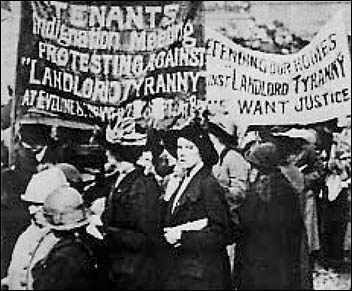
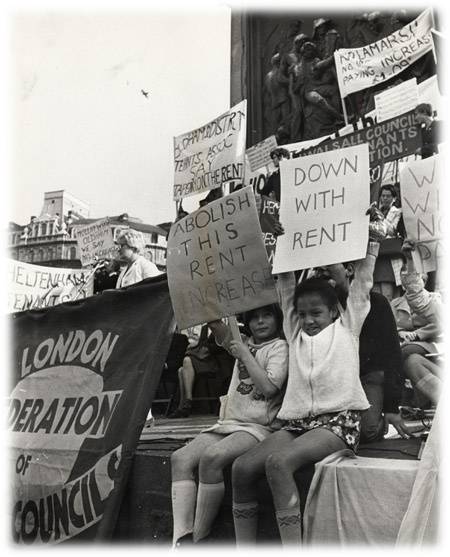
caps) will ensure that.Historically, housing struggles have tended to occur as a component of wider working class confidence and assertiveness in struggle, which tended to draw out the link between wages/income, housing costs and the relative class distribution of resources in society overall. Made more visible and explicit, in the process it became more contested. But what forms could this take today? There is no tenants' movement now comparable to the militancy of the 1950s, 60s and 70s when mass rent strikes and tenant struggles opposed, often successfully, government attacks on social housing. The large numbers of tenants, both unemployed and low waged, who depend in part or wholly on housing benefit (often paid direct to the landlord) have meant rent strikes were rarely a practical option, even if the will was there(17). But after years of low levels of struggle, will the present changes now face the emergence of a co-ordinated resistance? The need is urgent and it's way past due...
* * *
NOTES
1) See 'When the Lights Went Out: Britain in the Seventies' - by Andy Beckett; Faber & Faber, UK 2009, p. 422.2) 2011 figures recently released by the government reveal that - despite the scapegoating and exaggerations - benefit fraud only accounts for 0.8 per cent of benefit expenditure. See 'Table 1: Total Overpayments since 2005/06'; http://statistics.dwp.gov.uk/asd/asd2/fem/nsfr-final-160611.pdf
3) But the effect of numerous complaints to the European Commission by the European Property Federation and by private landlords since 2000 has resulted in the rolling back of rent control and security of tenure in the rented sector. In Holland since 1 Jan 2011 the state can no longer supply social housing to anyone earning more than €45,000 pa and even this compromise with the EC is under review.
4) http://www.guardian.co.uk/society/2008/jun/04/housing
5) http://www.insidehousing.co.uk/finance/associations%E2%80%99-spare-cash-soars-towards-%C2%A31bn-mark/6518070.article
6) On the subsidy claims, see an illuminating discussion here; http://www.insidehousing.co.uk/council-housing-is-not-subsidised/798.thread?PageNo=1&SortOrder=oldfirst&PageSize=20#comments
On the greater subsidies received by homeowners, see ‘Welfare-scrounging homeowners?’ by Q. Bradley; http://www.criticalplace.org.uk/?p=96
7) The 1988 Housing Act encouraged social housing landlords to seek private funding and the 2008 Housing & Regeneration Act encouraged private commercial investment and ownership in social housing.
8) Not all HAs are so legally defined; "Helena Partnerships Limited (formerly Helena Housing Limited) (HHL) recently lost its appeal against the First-Tier Tribunal (Tax)'s decision that it was not entitled to corporation tax relief (comprising £6 million plus interest) on rental income (Helena Partnerships Limited v HMRC [2011] FTC/42/2010). The Upper Tribunal (Tax and Chancery Chamber) held that HHL was not a charity because it was not established for exclusively charitable purposes." http://www.bllaw.co.uk/sectors/charities_and_not-for-profit/news_and_updates/charity_law_news_june_2011/housing_association.aspx
9) But most HA property development is, for the moment, still subsidised by government via Housing Corporation, Homes & Community Agency Social Housing Grant and grant-in-kind (gifts of cheap urban land). Typically this grant has been around 50%, but under the new Localism Bill it will be as low as 15% - and only available if HAs contract to deliver 80% market rents in return.
10) http://www.bbc.co.uk/news/uk-13507174
11) The Tory record so far on dishonest housing statements; http://www.insidehousing.co.uk/tenancies/security-breach-%28part-1%29/6515910.blog
12) A revision to planning rules has recently been made in an attempt to resolve this dilemma, but it appears only to be applicable to new build properties; http://www.communities.gov.uk/statements/corporate/affordablerent
13) http://england.shelter.org.uk/get_advice/housing_benefit_and_local_housing_allowance/housing_benefit_if_you_are_under_35
14) http://www.guardian.co.uk/society/2011/mar/05/benefit-low-income-households
15) http://www.standard.co.uk/business/markets/a-poor-way-to-integrate-as-housing-rules-are-relaxed-6415040.html Note in the “Shameless” picture and caption accompanying the article the snobby use of stereotypes of social housing tenants as thieving neighbours.
16) http://www.building.co.uk/comment/affordable-rent-a-numbers-crisis/5016908.article
17) Ironically, the recent proposal to restore paying housing benefits directly to all tenants may make rent strikes easier - though this would depend on what kind of tenancy one holds.
Published by Radical Islington
Online—June 2011
Hard copy—May 2012
This revised & updated edition—published October 2012
